
Full list of SQL Commands
The SQL Editor (Workbench > SQL Workspace) allows you to:
Register metadata from physical, logical, and streaming data sources in bulk
Manage metadata schema platform-wide
Run ad-hoc queries across virtual data sources
Materialise and cache virtual data sources
Run virtual data source statistics
Specify virtual data source partitions
Create permanent views and data marts of your virtual data sources
Configure security, LDAP integration, user management, and role-based access control
When you open SQL Workspace, the list of saved SQL queries (All Sql Scripts) is displayed. Click New Query to open a new query tab, or click a saved query to open it. Use Favorites to show your favourite queries, and Open Editor to return to the query tabs that are already open.
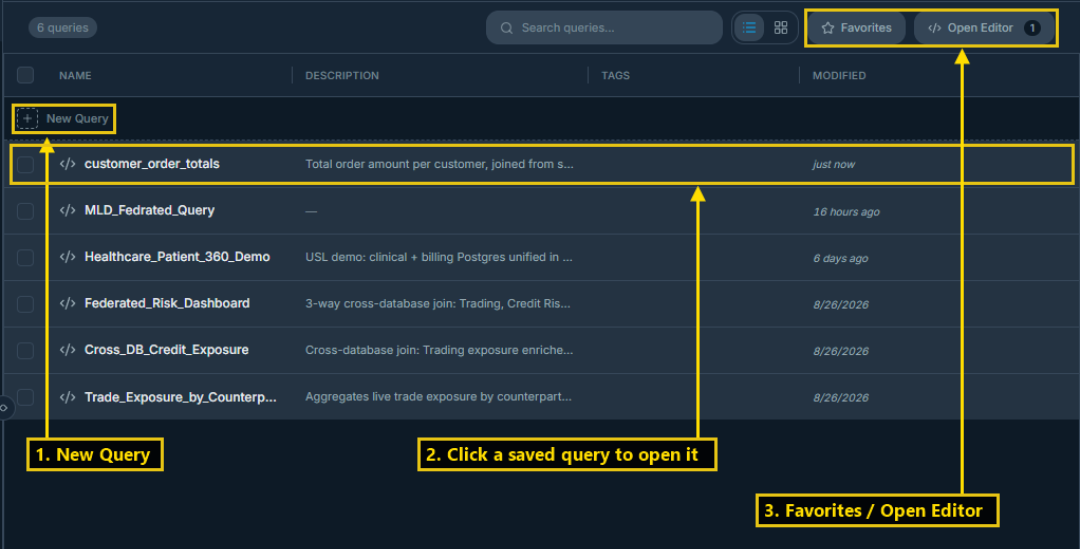
Saved SQL queries
In the left panel, you can view Data Explorer. Here you can view all the virtual databases, data sources, streams, data marts, and views for use in any query.
The SQL Editor toolbar is at the top of the editor. It allows you to perform the following functions:
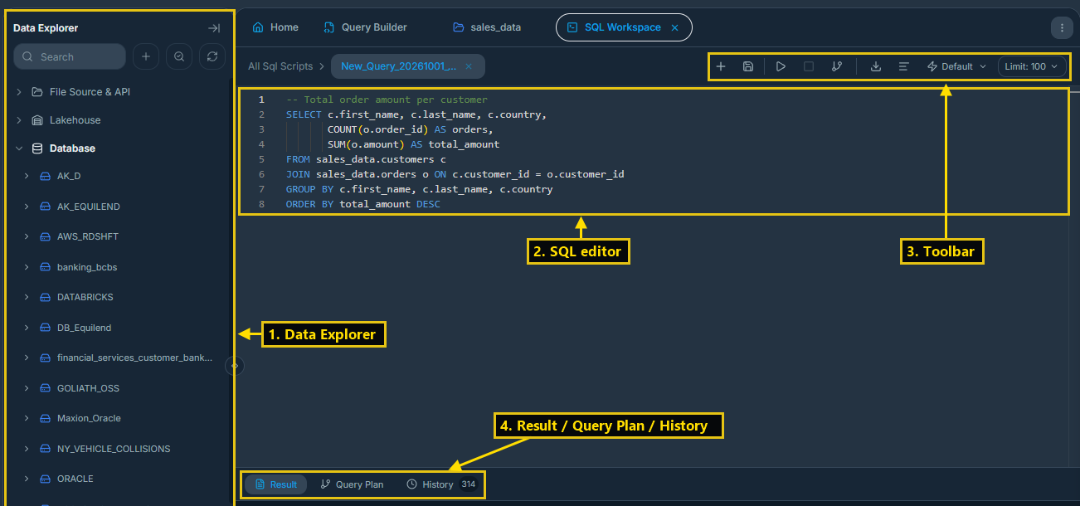
SQL Workspace editor
New Tab (+) - adds a new query tab.
Save (Ctrl+S) - saves new or edited SQL queries with a name and description.
Execute (Ctrl+Enter) - executes the SQL code in the editor, or the SQL code that has been highlighted.
Stop (Alt+S) - stops SQL query execution.
Plan (Alt+Q) - displays the query execution plan in the Query Plan tab.
Export (Alt+E) - exports the query output.
Format SQL - displays the SQL code in the editor in a human-readable format.
Engine selector - selects the compute engine used to run the query (for example Default Spark, or a Presto engine).
Limit - sets the maximum number of results to be returned by a query (10, 50, 100, 500 or 1000).