
Use the Query Builder to build a query and save it as a view interactively, using drag and drop. Zetaris generates the SQL statement automatically as you work.
To open it, go to Workbench > Query Builder. Views are organised in containers: open a container and click New View, enter a View Name and click Create. To edit an existing view, click its name.
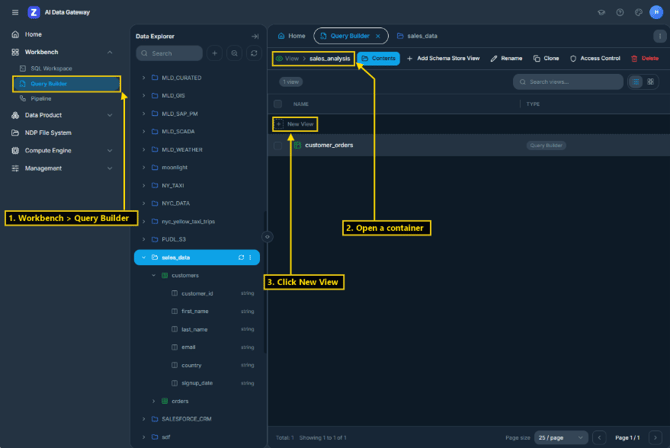
Query Builder containers and views
The Query Builder editor has the following areas:
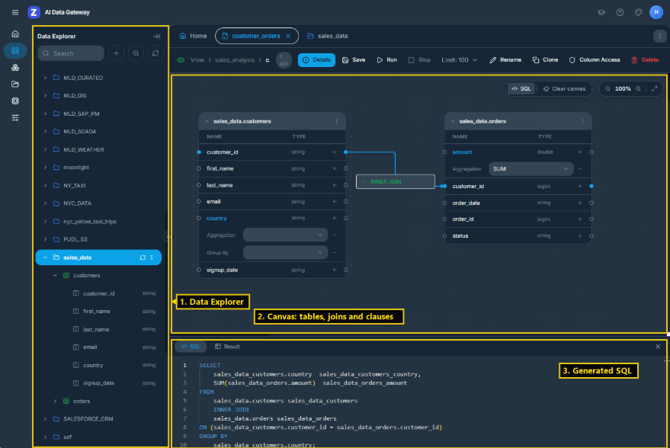
Query Builder Overview
Data Explorer - This panel lists all available data sources, data marts, streams, pipeline tables and views. Drag a table from here onto the canvas to use it in the query.
Canvas - In this panel, you view the tables on the canvas, join them and add clauses to build the query. To join two tables, click the connector dot next to a column in one table, then click the matching column in the other table. An INNER JOIN is added between them.
Clauses - To add a clause to a column, click + next to the column, choose the clause type and click Add. The available clause types are Select Column, Expression, Predicate, Group By, Having and Order By.
Adding a clause to a column
The grouping options are set on the column in the canvas:
Aggregation - Applies an aggregate function to the column: AVG, COUNT, SUM, MIN, MAX, COUNT DISTINCT, COLLECT_LIST, COLLECT_SET, FIRST or LAST.
GROUP BY - The columns with the Group By clause are used in the GROUP BY section of the generated SQL query.
CUBE - Select CUBE in the Group By dropdown to apply the CUBE grouping operator to the GROUP BY.
ROLLUP - Select ROLLUP in the Group By dropdown to apply the ROLLUP grouping operator to the GROUP BY.
Aggregation and Group By (CUBE / ROLLUP) options
SQL - Returns the SQL generated from the Query Builder actions. It updates as you add tables, joins and clauses.
Result - Output from running the query. Click Run to execute the query and Save to save the view.
Running the query and viewing the result
Example: total order amount by country
1. Drag customers and orders from Data Explorer onto the canvas.
2. Join customers.customer_id to orders.customer_id.
3. On country, add Select Column and Group By.
4. On amount, add Select Column and set Aggregation to SUM.
5. Click Run to see the total amount per country, then click Save.